A practical SEO academy for small teams
Design a practical learning program built around assignments, feedback and real website decisions.
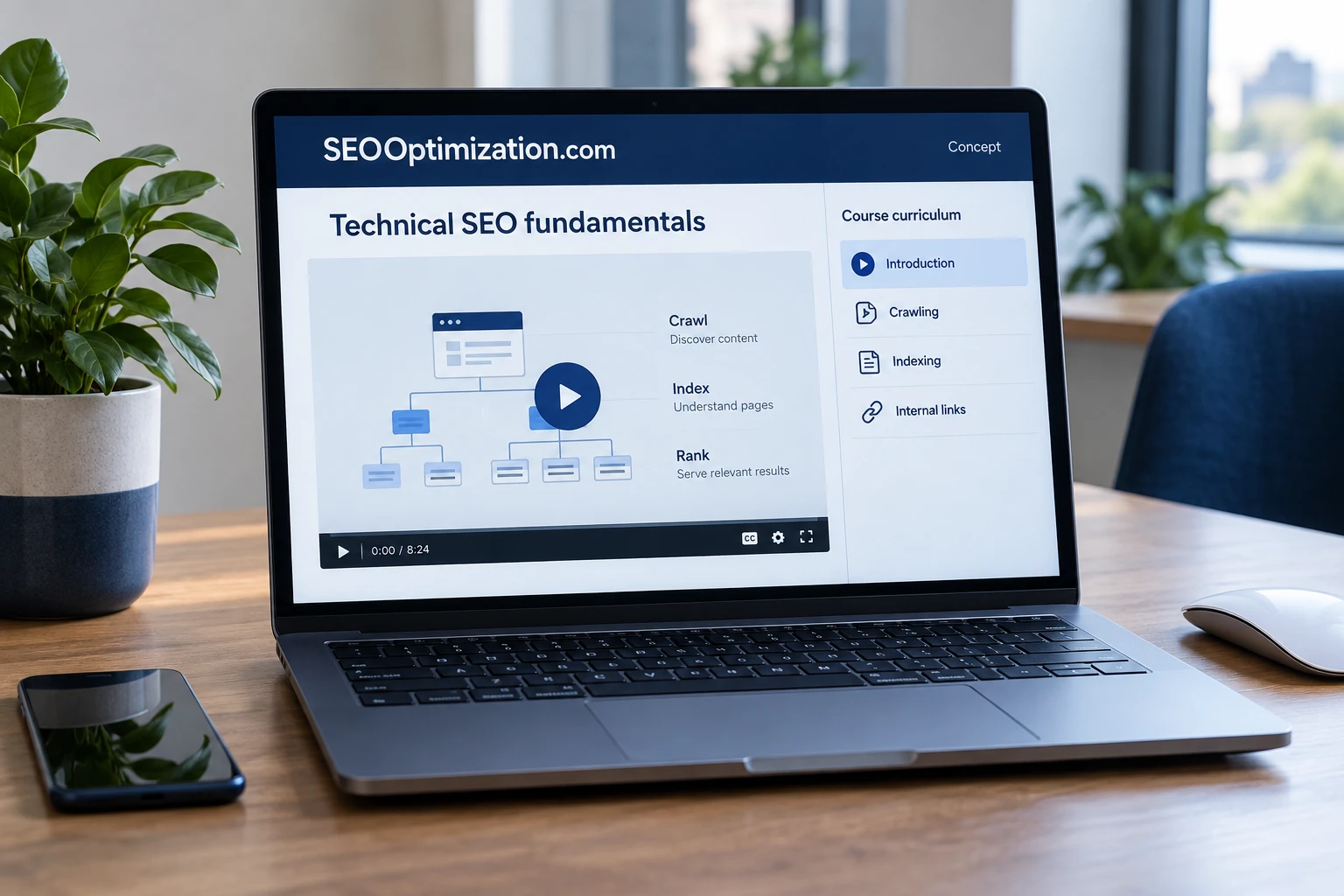
A small marketing team can finish an introductory SEO course and still feel unsure about the next change to make on its website. The missing piece may be supervised practice: choosing a page, gathering evidence, making a bounded improvement and explaining what happened. An education business could organize its offer around that sequence.
This is an illustrative academy concept for SEOOptimization.com. It describes a possible training business, not an existing course or an accredited institution. Its intended customer is a working marketer who has access to a website and needs a clearer way to carry out routine search tasks. The domain could give the curriculum, enrollment information and learner resources one descriptive address.
Choose a learner with permission to practice
Define prerequisites before designing lessons. Participants should understand their organization's offering, be able to review its public pages and know who approves changes. Some may have publishing access; others may need a developer or manager to implement a recommendation. Both can participate if the assignments account for that difference.
Provide a demonstration website for anyone who cannot use a work property. That keeps the class accessible without encouraging people to expose confidential data. Ask learners to use sanitized examples when discussing company information. A training session should never become an accidental public audit of a customer's private systems.
The promise can be specific: complete a small set of documented exercises and receive feedback on the reasoning. Avoid guarantees about employment, income, ranking or traffic. Those depend on many conditions outside a course, including the learner's role and the website itself.
Build a six-week sequence around decisions
The first week could teach learners to describe a page's audience and purpose. The assignment is a short page brief: who needs the page, what question it answers and what action should be possible after reading it. Instructors can give useful feedback without reducing the exercise to keyword repetition.
The second week could cover discovery and access. Learners inspect a small group of pages, identify how people reach them and distinguish a missing link from a page that is intentionally unavailable. Google's SEO Starter Guide provides a public foundation, while the exercise turns that reading into a concrete observation.
Week three could examine titles, headings and page content. Each participant proposes one improvement and explains its purpose. Week four could introduce internal linking and site organization through a small navigation map. The instructor should challenge changes that make the site less useful merely to satisfy a checklist.
Week five could focus on measurement. Learners define a baseline and note the limitations of the data they can access. Week six could bring the work together in a short review: the original problem, the chosen action, what was implemented and what remains uncertain. The final presentation should make the reasoning visible.
Make feedback the core product
A video library is easy to expand and difficult to keep focused. Instructor time is scarce, so plan where it matters most. A written comment on a learner's evidence may be more useful than another hour of general lecture. Use a rubric that rewards a clear question, appropriate evidence, a feasible action and honest limits.
For example, a learner might propose changing every page title because a tool flagged duplicates. The instructor can ask which duplicates reflect genuinely similar pages, which titles are confusing and who owns the relevant template. The point is to develop judgment before someone applies a sweeping change across a live property.
Offer a predictable feedback schedule and define the boundaries of support. A course should say whether it includes code review, access troubleshooting or private consulting. Those services can consume far more time than the lesson plan suggests. Clear boundaries help both the learner and the operator plan their work.
Use measurement without promising a result
The academy could teach a simple reporting routine using the Search Console performance report. Learners can compare selected pages or queries and explain what a metric does and does not describe. They should also record the period and filters used so another person can reproduce the view.
An assignment might ask a learner to distinguish an implementation check from an outcome check. Confirming that a title changed is one task. Assessing whether search behavior changed is another. A useful submission can conclude that the evidence is too limited to judge an effect. That is better analytical practice than forcing every lesson to end with a success chart.
Test one workshop before building the academy
Start with a single workshop, such as turning one website observation into a clear implementation brief. Recruit through professional communities, marketing teams and partnerships with web studios that already answer beginner questions. Publish an example assignment so prospective learners understand the level and expected effort.
Afterward, ask participants which step they completed independently and where they needed help. Review instructor preparation time, feedback time and the support questions that arrived later. Those observations will shape the format, cohort size and pricing far more reliably than guessing how many modules a full course should contain.
Accessibility also belongs in the pilot. Provide readable materials, captions for recorded lessons and an alternative to live participation when feasible. Test the assignment instructions with someone unfamiliar with the terminology. A confusing worksheet can undermine a good lesson before the instructor sees any work.
Give the concept a clear next step
The academy would need qualified instructors, a maintained curriculum, a workable enrollment process and a plan for updating examples as tools change. Its strength would come from feedback and practice, not simply the number of videos available.
SEOOptimization.com could become the home for that focused learning experience. A buyer interested in the address can inquire about acquisition and outline the training audience. The practical business experiment is smaller: run one workshop, inspect the completed assignments and decide whether learners need a longer supported program.