Software that turns search findings into assigned work
Build a focused tool that carries search issues from discovery through release and verification.
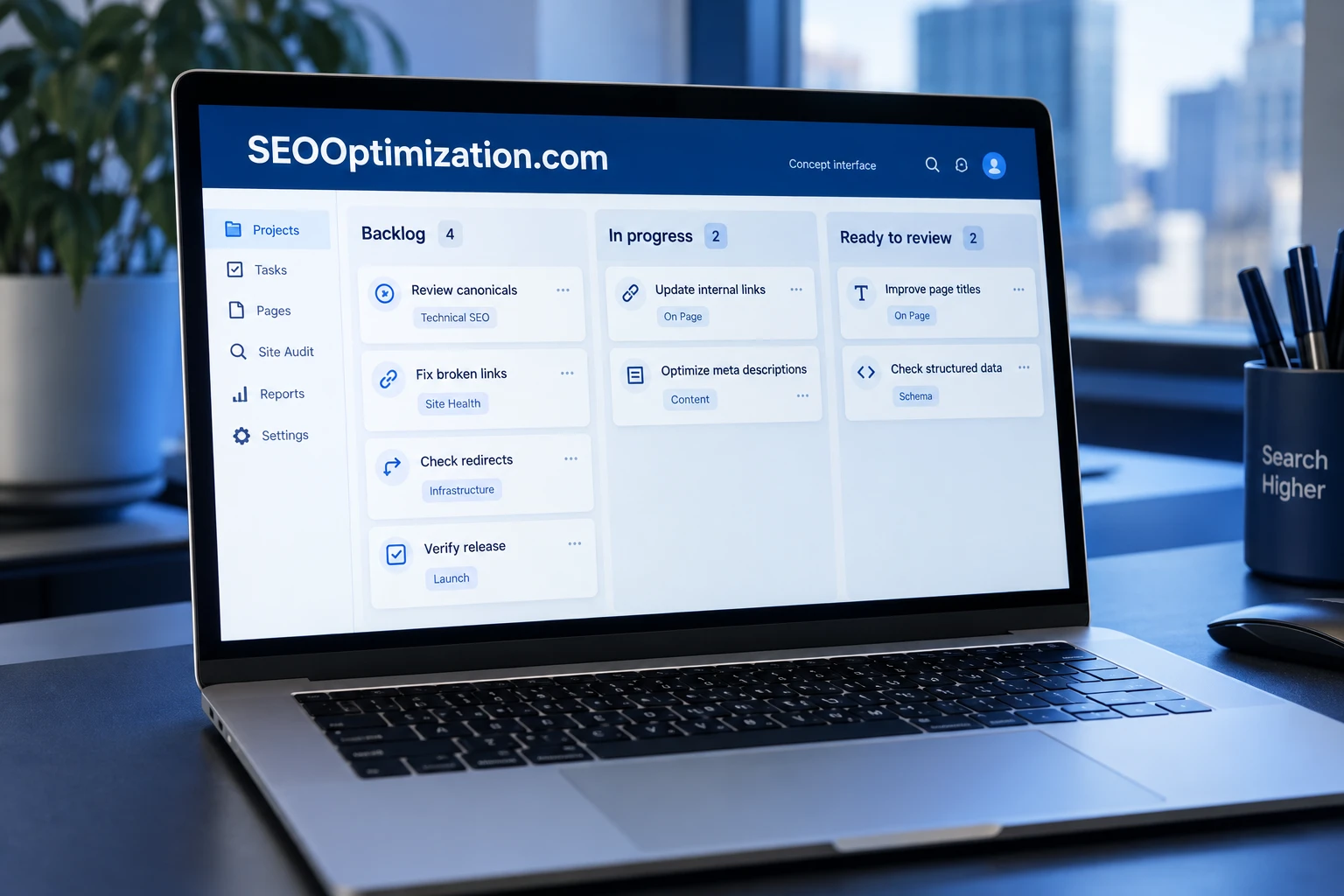
Many search teams already have ways to discover problems. Their harder task is turning findings from different tools into work that someone owns, ships and checks. A focused software product could serve that middle part of the process. Its first useful screen might be an issue board with clear evidence and responsibilities, rather than another dashboard filled with scores.
This illustrative concept uses SEOOptimization.com as the possible identity for a search workflow product. The proposed buyer is an in-house marketing team that works with developers and content editors. No working software, integrations or customer base is included in the domain offer. The concept is a starting point for product discovery.
Begin with a handoff, not a feature list
Interview a marketing lead and a developer from the same team. Ask them to bring one recent search-related task and explain its journey from discovery to release. Look for repeated confusion: duplicate reports, missing examples, unclear ownership, decisions lost in chat or issues marked complete before anyone checks the page.
Choose one recurring failure to address. For example, an issue may appear in three tools but describe a single template problem. A product that helps the team group those findings, attach evidence and assign one implementation task has a coherent purpose. Adding rank tracking, content generation and billing immediately would make that purpose harder to test.
Define the smallest useful record
A first issue record could contain a short title, affected URL examples, the source of the finding, a written explanation, an owner and a next review date. Keep separate fields for implementation status and verification status. "Released" and "Verified" represent different events, and the product should make that distinction visible.
Allow the person reviewing a finding to mark it as accepted, rejected, duplicate or needing more evidence. A rejected warning can be a good outcome if the team documents why it does not apply. The system should preserve that decision so that the same warning does not return as unexplained urgent work every week.
Start with an import that the team can inspect. A simple CSV upload may be enough to test the workflow before direct integrations. Show the field mapping and let the user preview records before creating tasks. Make it possible to undo the import without deleting unrelated work.
Work through an illustrative release
Imagine a team reviewing internal links after a category migration. A marketer imports the affected URLs and groups them by source template. The developer adds an implementation note and estimates the change. The editor confirms which destination pages are intended to remain available. One shared record now contains the context that previously sat in separate messages.
When the change ships, the owner records the release date and attaches the pages that need checking. A reviewer confirms that the intended links resolve and closes the verification step. If one template still points to an old address, that exception remains open. The product makes an unfinished task visible instead of allowing a green summary to hide it.
This example suggests a useful product test: can an unfamiliar teammate understand the issue, its current state and the next action without a meeting? If the answer is no, more analytics probably will not solve the problem. Improve the record and the handoff first.
Be precise about data access
A later integration might use the Search Console Search Analytics API to bring selected search information into a review. Its documented limitations matter: it does not promise every data row. The product must describe what was imported, the selected period and any relevant gaps rather than calling an incomplete export a full record.
Use a permission model that matches the product's job. A reporting feature should not request write access merely because a broader scope is convenient. Google's authorization documentation describes the API access mechanism; the product team still needs to design secure storage, revocation and customer account separation.
Customers should be able to disconnect a source, export their work and understand retention. These are product requirements from the first pilot, not details to bolt on after the team has accumulated sensitive website data. Avoid collecting credentials in ordinary support messages.
Sell a narrow pilot with a clear question
Recruit a few design partners whose teams have similar workflows. Ask them to run a real release through the prototype and observe where they leave it for spreadsheets or chat. Charge for a bounded pilot only when the offer and expectations are clear. Do not count a polite demo reaction as evidence that a team will use the product regularly.
Measure useful operating signals: whether tasks gain owners, whether duplicate work decreases and whether reviewers can find the evidence they need. These are proposed product measures, not promised customer outcomes. Pair them with interviews so that the product does not optimize a status field while leaving the underlying work unchanged.
Distribution could begin with a practical template for writing SEO implementation tickets, shared through communities for in-house marketers and technical teams. A template that explains the workflow can introduce the product's purpose more directly than a broad claim about doing all SEO in one place.
Decide what comes after the first version
Expand only when a repeated need appears across pilots. A release checklist, issue history or approval step may deserve attention before another data connector. Keep an explicit list of requests the product will defer, and explain those boundaries to pilot customers.
SEOOptimization.com could support this product's identity, documentation and acquisition funnel. To discuss acquiring the address, send a domain inquiry describing the intended software concept. To test the business itself, start with a clickable issue-to-release workflow and ask three teams to use it on work they already need to finish.