A technical SEO studio for complex websites
Turn complex website findings into scoped development work, with evidence, ownership and retesting.
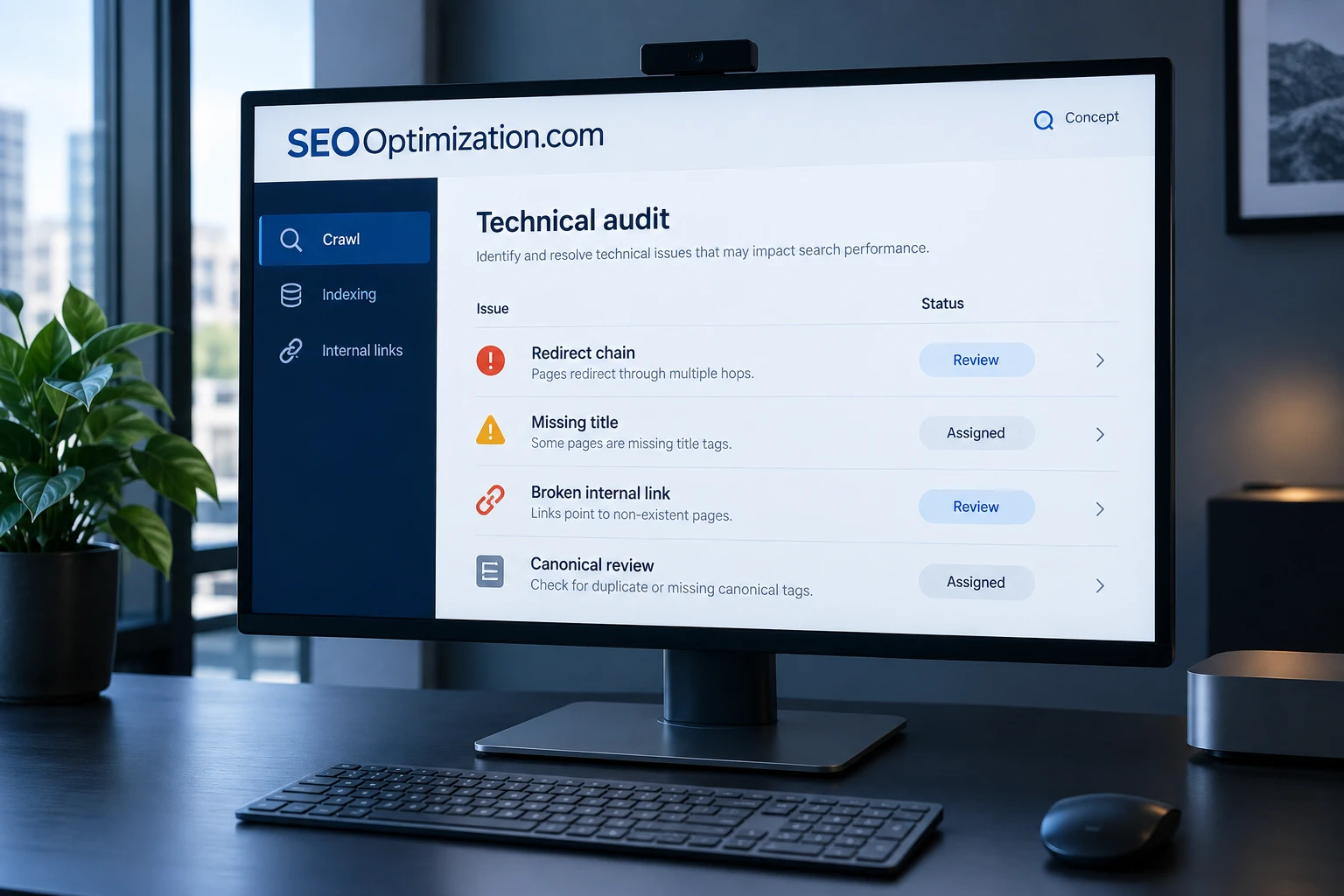
A useful technical SEO business starts with a specific customer problem. An ecommerce team has thousands of product URLs, several people publishing changes and a backlog that nobody quite owns. Its marketing lead can see that something needs attention, but a long spreadsheet of warnings does not tell the developers what to ship next. A specialist studio could make that handoff its first offer.
This is an illustrative business concept for SEOOptimization.com. The domain could introduce a practice focused on diagnosing website problems, documenting decisions and helping teams verify fixes. The commercial opportunity would depend on the operator's expertise and delivery, not on the address creating a search advantage.
Pick a customer whose workflow you can understand
Start with one type of website and one buying situation. A studio for established online retailers has a different job from an agency helping local tradespeople publish their first websites. Retail teams may need help with category navigation, product variants, filtering, discontinued products and releases that affect many URLs at once. The first conversations should establish who controls those systems and what the team can realistically change.
Ask a prospective customer to walk through the last technical recommendation that reached production. Who identified it? Who approved it? How was it tested? What happened when the result was uncertain? Those answers reveal the service gap more clearly than asking whether the business wants more traffic. They also expose engagements that would stall because nobody has access or implementation capacity.
Make the first offer small enough to finish
An initial engagement could cover a defined group of category and product templates. Its deliverables would be a verified issue list, representative examples, a prioritized implementation plan and one review meeting with the people doing the work. State the templates, environments and review period in the scope. Define what additional investigation would require a separate agreement.
The studio should explain the difference between an observed issue and a hypothesis. A broken internal link can be reproduced. The expected effect of changing a category introduction is more uncertain. Both may deserve attention, but they need different evidence and acceptance criteria. A customer should be able to tell which recommendations address a known defect and which are experiments.
Google's SEO Starter Guide provides a useful reference for discussing crawlability, clear organization and helpful content. It also makes clear that following advice does not guarantee a particular search position. Keep that distinction in proposals and customer conversations.
Turn a finding into a usable development ticket
Consider an illustrative retailer whose filter combinations create several addresses for similar category content. A weak ticket says, "Fix duplicate pages." A useful ticket identifies the affected template, provides example URLs, explains the intended behavior and identifies the person who must confirm the product requirements.
The ticket might ask the team to review which filtered pages deserve distinct content and which should consolidate. It should include a test case for each agreed behavior, an implementation dependency and a rollback note. Google's canonicalization guidance is relevant when evaluating consolidation options. The right choice still depends on the site's actual pages and intended use.
Acceptance could mean that the agreed canonical signal appears in rendered output, internal links point to the intended addresses and the changes do not break navigation. A later observation can assess how search systems respond. Do not confuse a successful deployment with proof of ranking improvement.
Build a repeatable delivery process
Before work begins, agree on access, backups, communication and responsibility for publishing changes. Use the least access needed. Keep customer exports and credentials out of shared presentation files. Maintain a short decision record so that a developer joining halfway through the engagement can understand why a recommendation exists.
Schedule a technical handoff before the report becomes final. Developers can often identify constraints that change the order of work. A recommendation that requires a platform migration should not sit beside a small template fix as though both could be finished in an afternoon. Separate immediate repairs, planned improvements and unresolved investigations.
Retesting should be part of the offer. Record which examples were checked, when they were checked and whether the original issue remains. If the customer declines implementation, close the recommendation as deferred rather than presenting it as a completed result. That modest discipline can make the service easier to trust.
Find customers through a specific demonstration
A credible distribution path is an educational teardown of an intentionally created demonstration website. Show one reproducible technical problem, the evidence needed to understand it and a well-written development ticket. Avoid publishing an unsolicited diagnosis that exposes a real company's sensitive information or implies a customer relationship.
Share that demonstration with ecommerce development partners and in-house marketing communities where this exact handoff problem comes up. A small workshop for developers and marketers together could be more useful than another generic SEO checklist. The next conversation should be about the team's implementation process, not a promise of quick rankings.
Test the offer before expanding it
Run one bounded pilot and review the operating economics honestly. Track investigation time, meetings, rework and retesting. Ask which deliverable the customer actually used. If most value came from translating findings into tickets, build around that service instead of adding unrelated packages.
SEOOptimization.com could provide a descriptive home for this specialist practice, its public examples and its inquiry path. A prospective owner can inquire about the domain with the intended business model and stage of development. The first business step is separate: interview several ecommerce teams and confirm that the implementation gap is important enough for them to address.